Current Sensor Output and Wiring Configuration - Wekewei - Free Technical Manual
万彩网100线路Current sensors with switch outputs are typically used to excite loads such as relay coils or PLC inputs, and there are multiple sensor output configurations that can be used in conjunction with these loads. In this article, we will investigate the most common types of standard outputs, their wiring, and the advantages and disadvantages of each type.
How to complete current switching
A standard current sensor needs to be connected to a power source to function and includes an output circuit that includes a solid-state switching element, such as a transistor or thyristor. When triggering this output circuit, the normal state of the switch will change: normally open switch is closed, normally closed switch is open. Because the switching element is a solid-state contact rather than a dry contact, there is always a voltage drop when it is closed, and there is always a leakage current (also known as the cut-off state current) when it is opened. These values depend on the output circuit design and are listed in the sensor's data sheet.
Issues to consider when selecting output types
Available power supply - Most standard DC sensors operate within a voltage range of 10 VDC-30 VDC, while AC sensors operate within a voltage range of 20 VAC-250 VAC. Some models are AC/DC and can use any power source within a wide range, such as 20 VAC/VDC-250 VAC/VDC.
Load characteristics - The maximum leakage current of the sensor must be lower than the off state threshold of the load, otherwise even if the switching element of the sensor is turned off, the load will still be powered on. In addition, the load current when the switch is closed must be greater than the minimum on state current of the switch (also known as the minimum operating current). This information is listed in the sensor data sheet.
Standard sensor output type
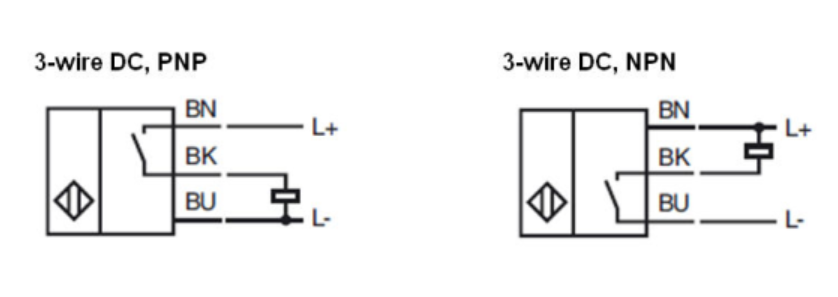
万彩网100线路3-wire DC - When using this type of output, the sensor is connected to the power supply using two wires, while the switch output is on the third wire. Due to this separation, when the sensor is correctly connected to the load, the power supply current will not pass through the load and the leakage current will be minimized. 3-wire output typically provides PNP or NPN switching elements. PNP output provides current (switching the load to DC positive) and requires PNP output when the other end of the load is connected to DC negative. When the other end of the load is connected to the DC positive pole, NPN output will be used, which absorbs the current (switching the load to the DC negative pole). These two types of connections are shown in the following figure, where the large box on the left is the sensor and the power supply is connected on the right.
万彩网100线路Advantages of Three Wire DC Output
万彩网100线路Low leakage current
Typical short-circuit protection
万彩网100线路Easy to test, no load required, only power supply and sensor output LED
万彩网100线路Universal, ready-made, multiple configurations
There is also a 4-wire system, including normally open and normally closed outputs
万彩网100线路Disadvantages of Three Wire DC Output
万彩网100线路The load must be connected according to PNP or NPN configuration
万彩网100线路More wires need to be dealt with